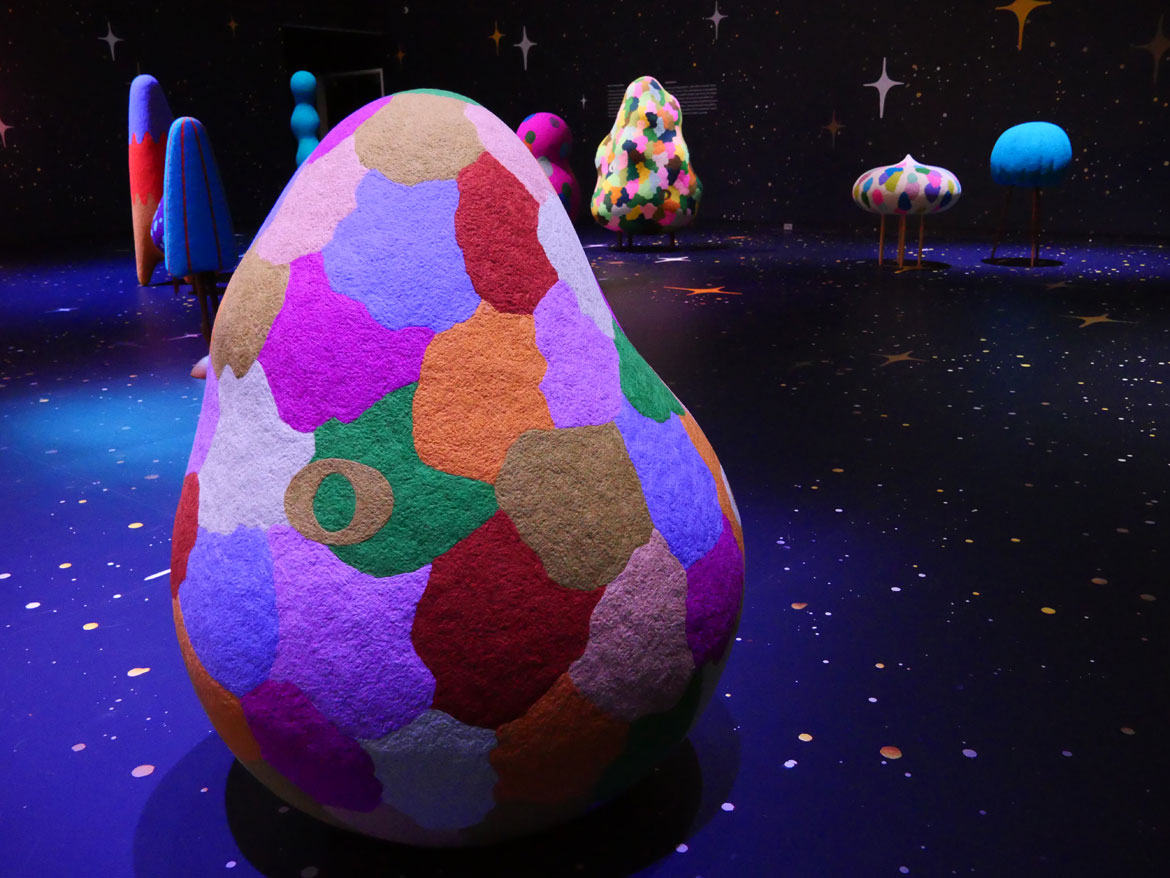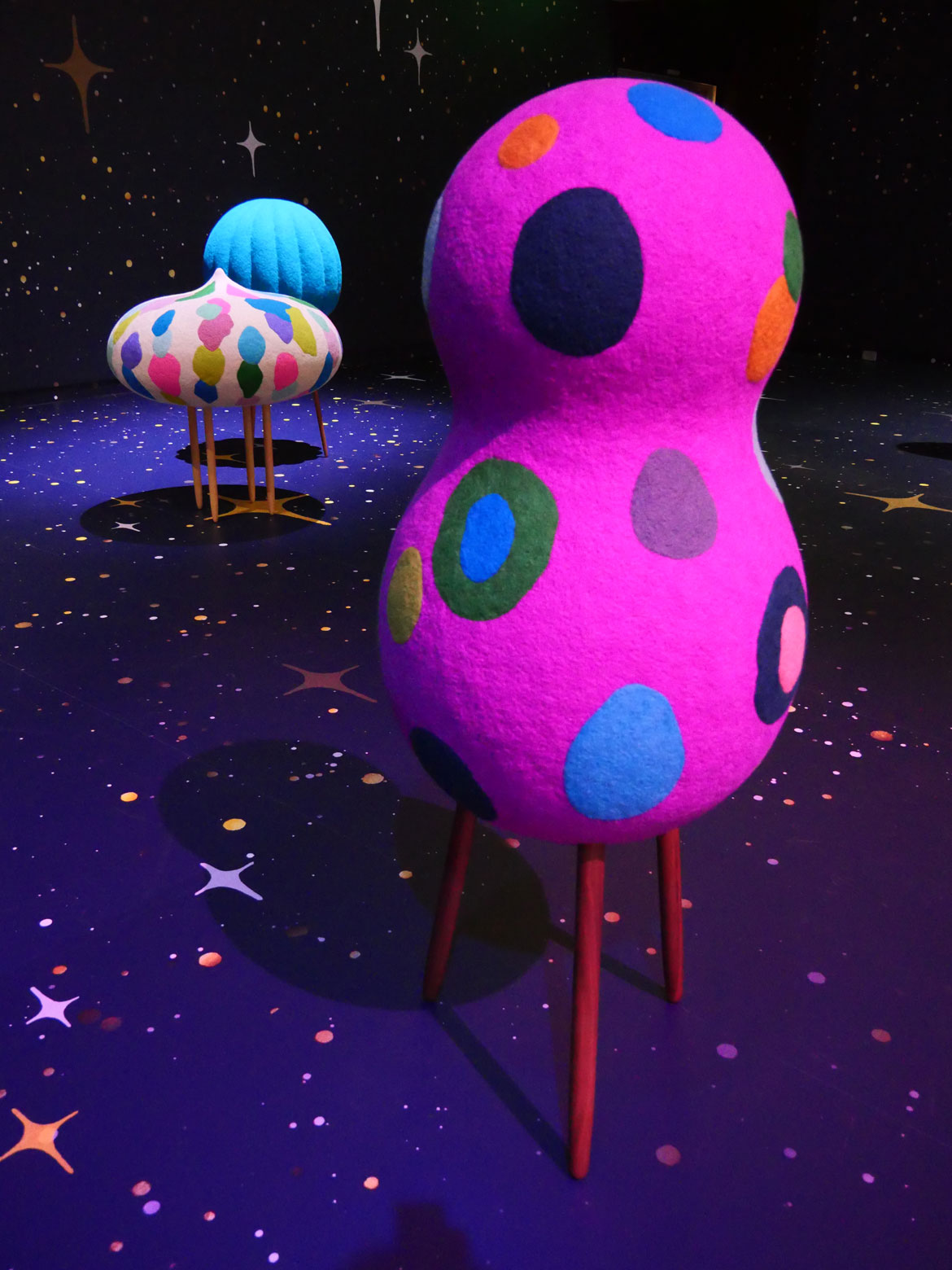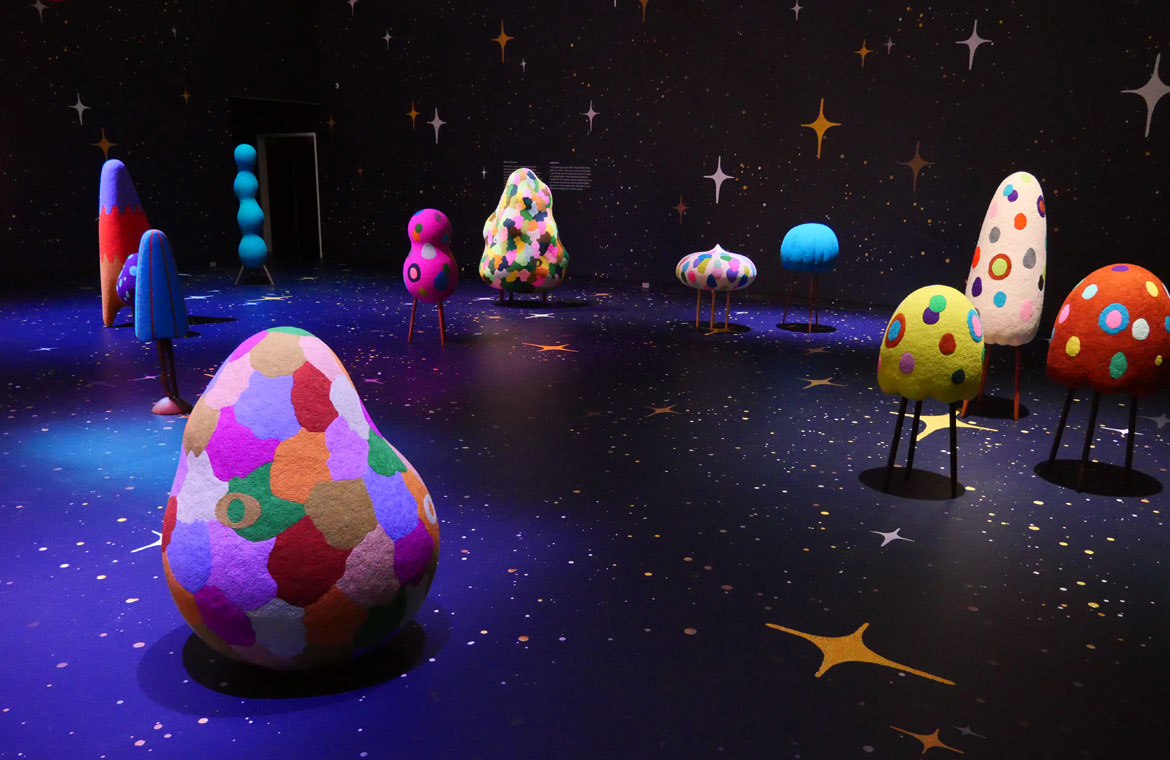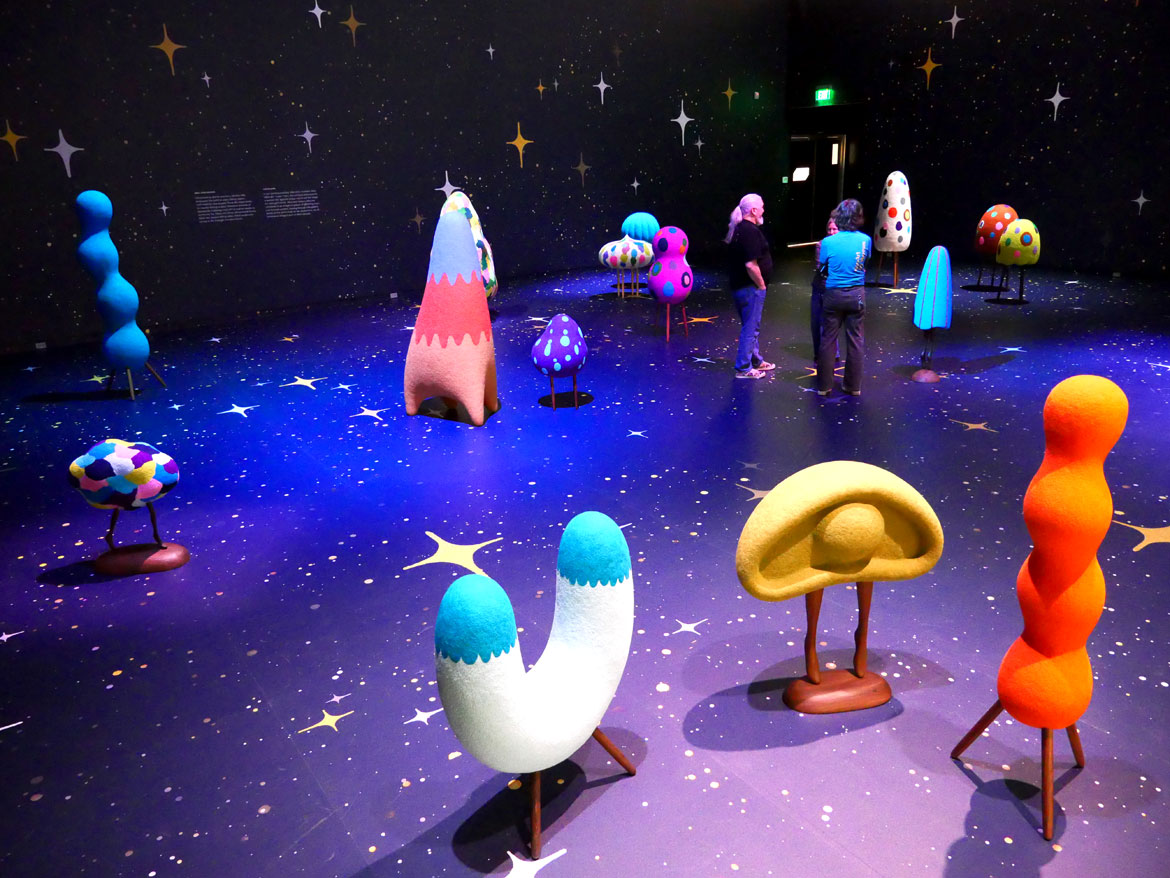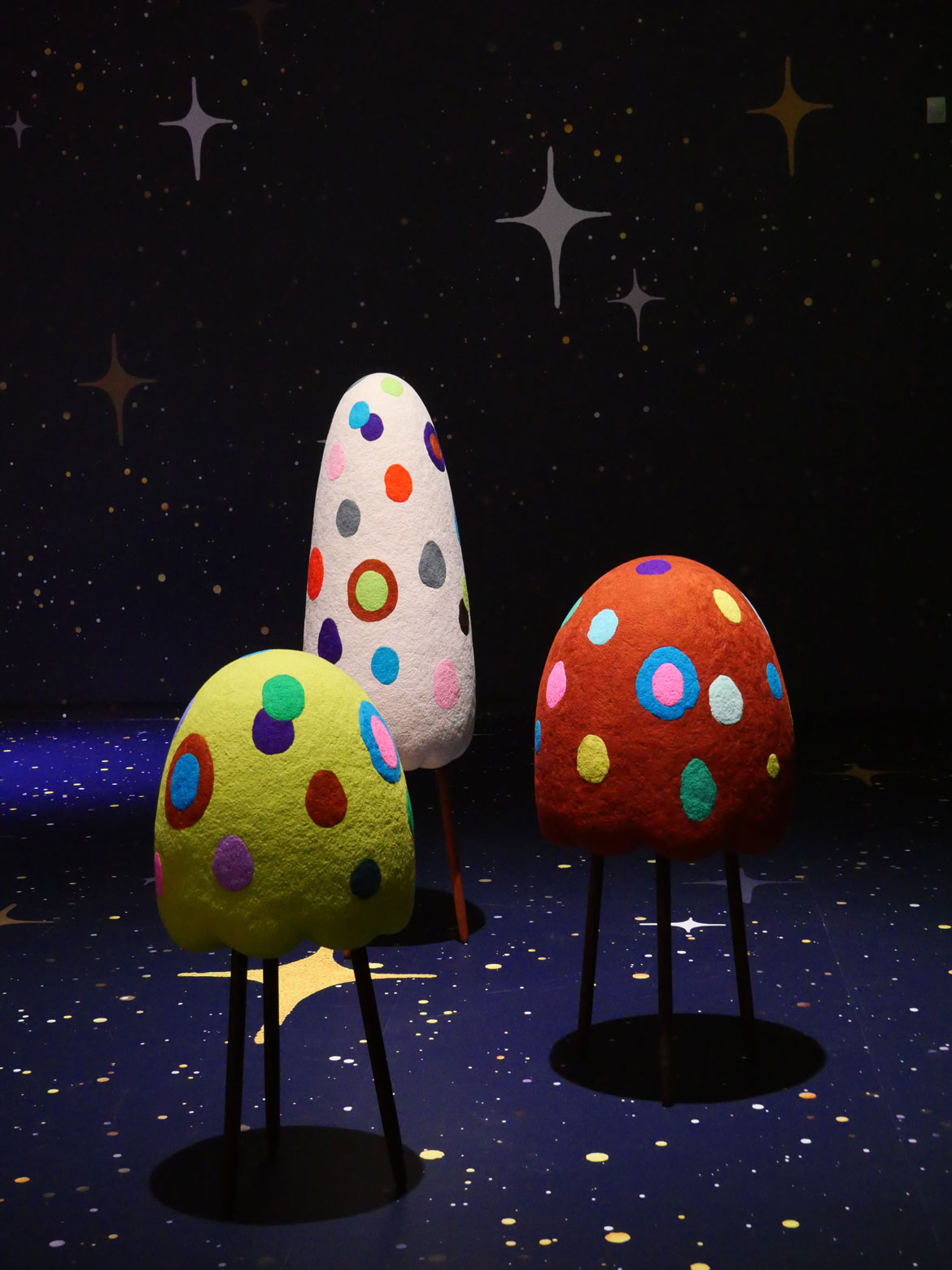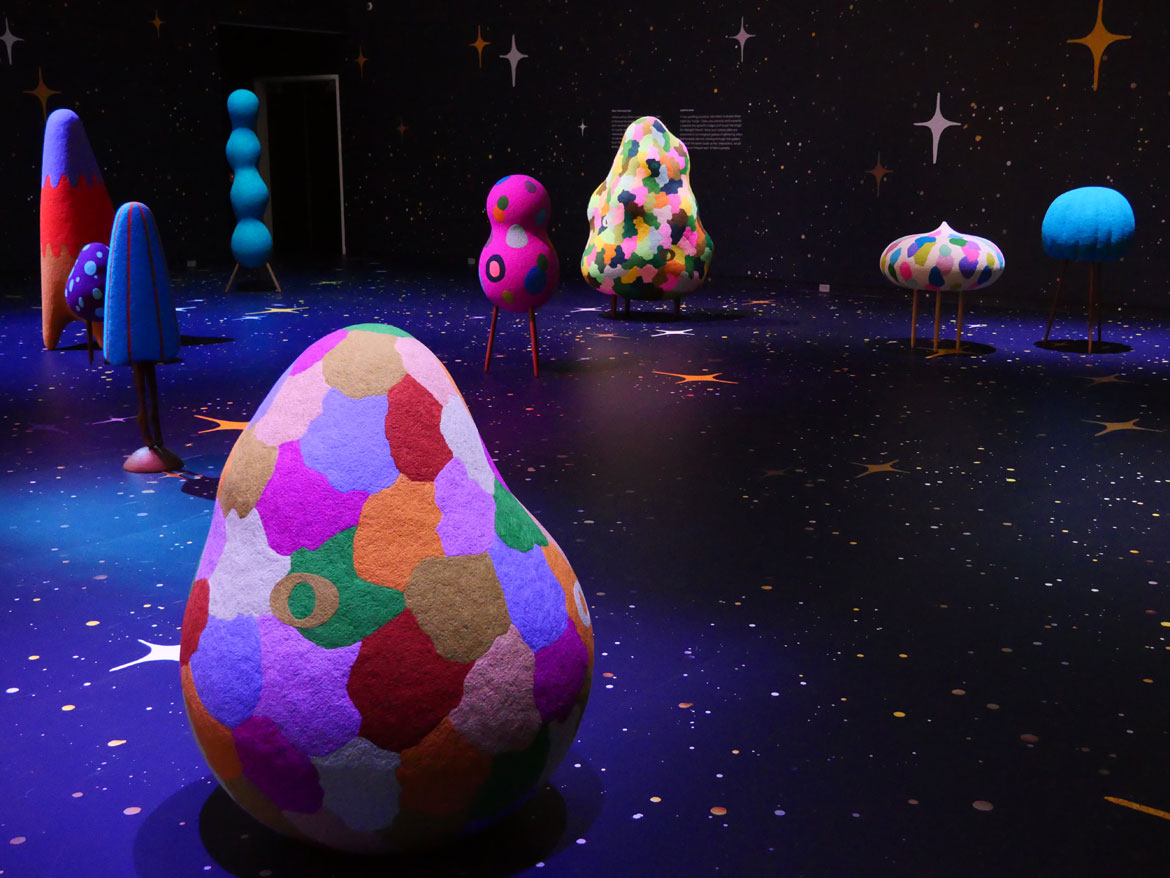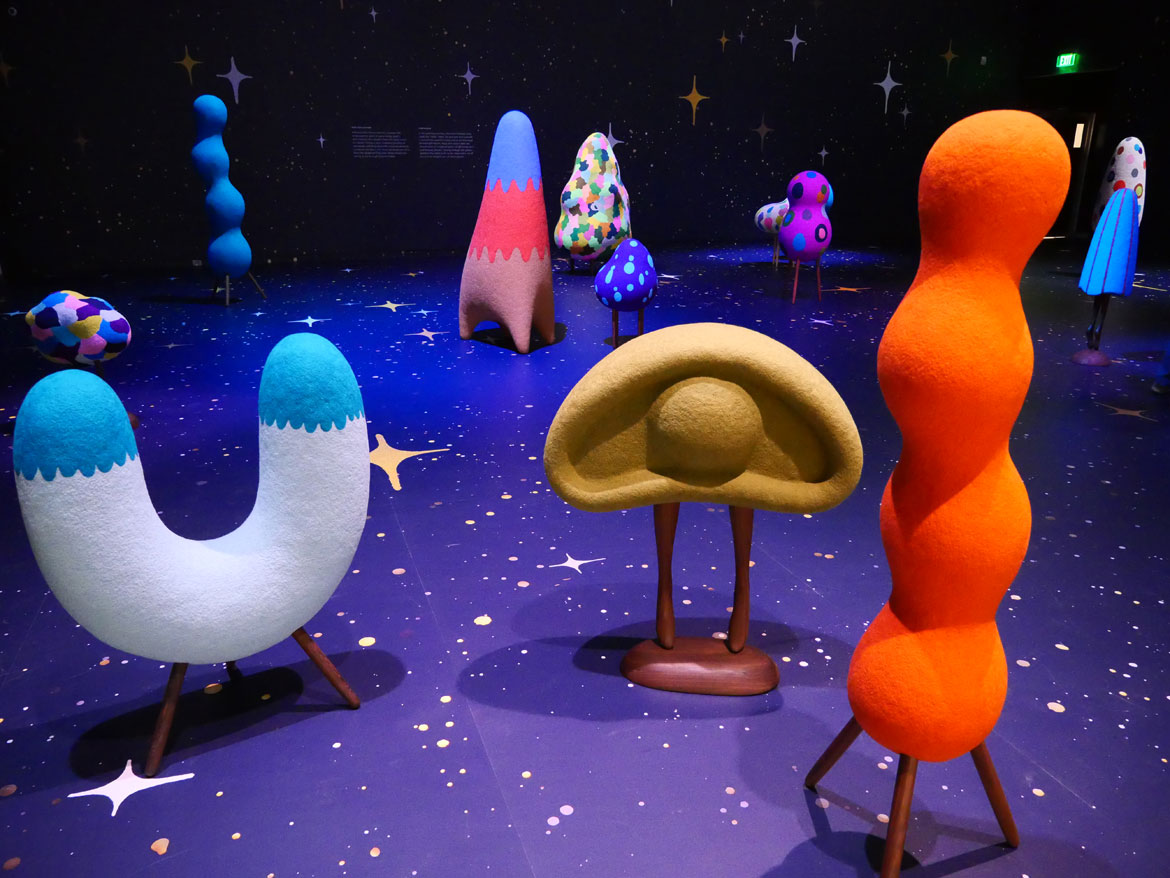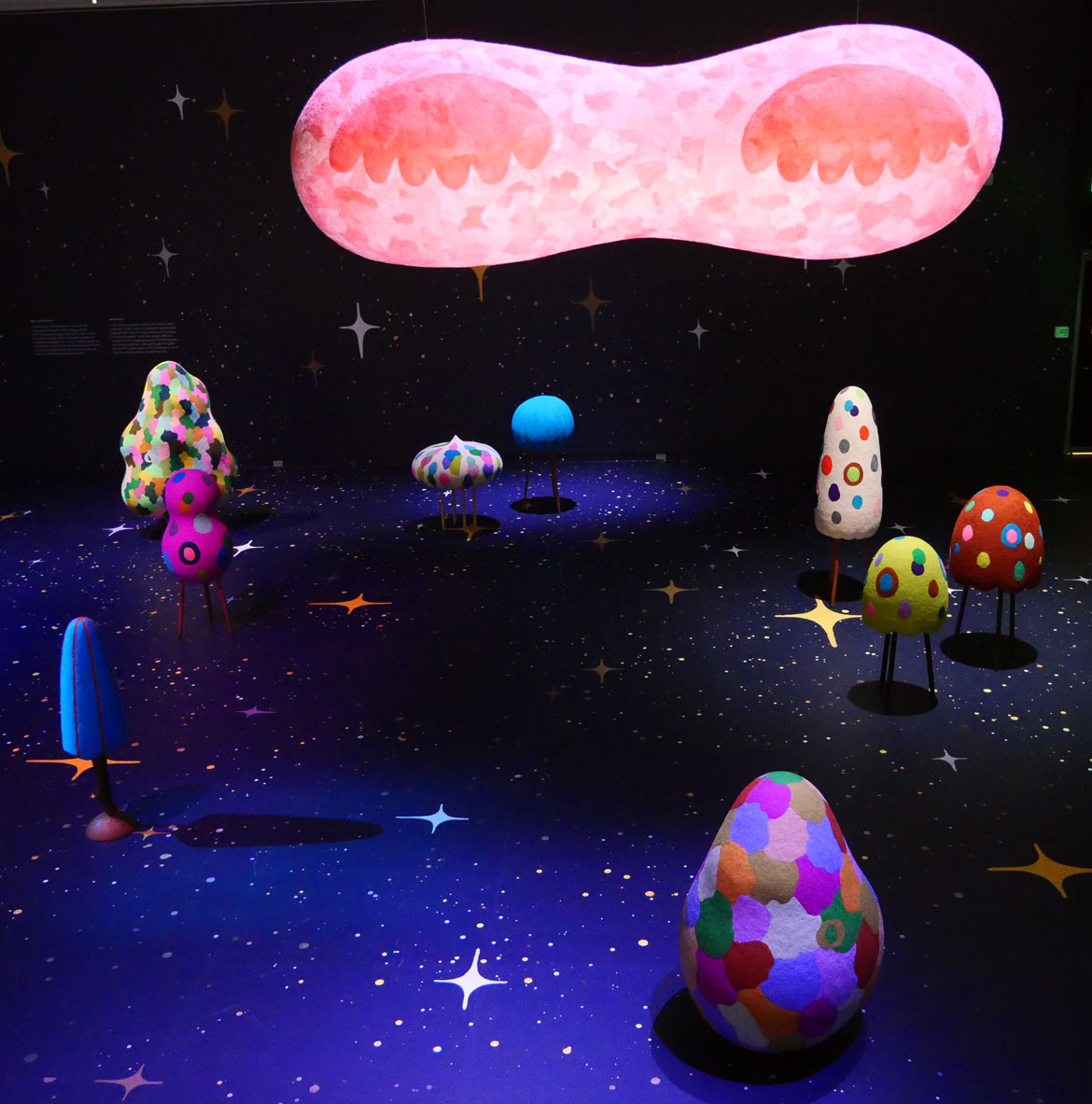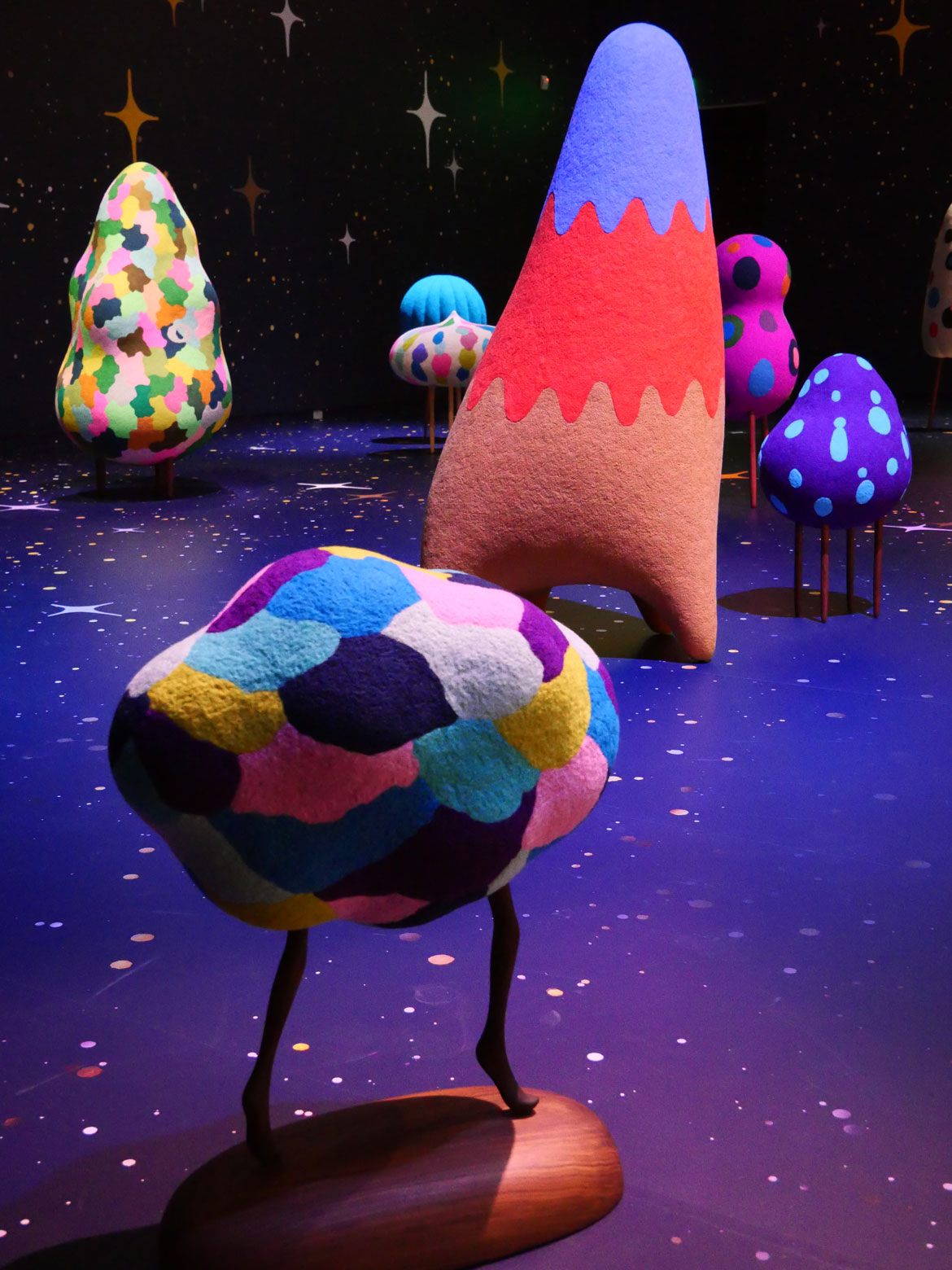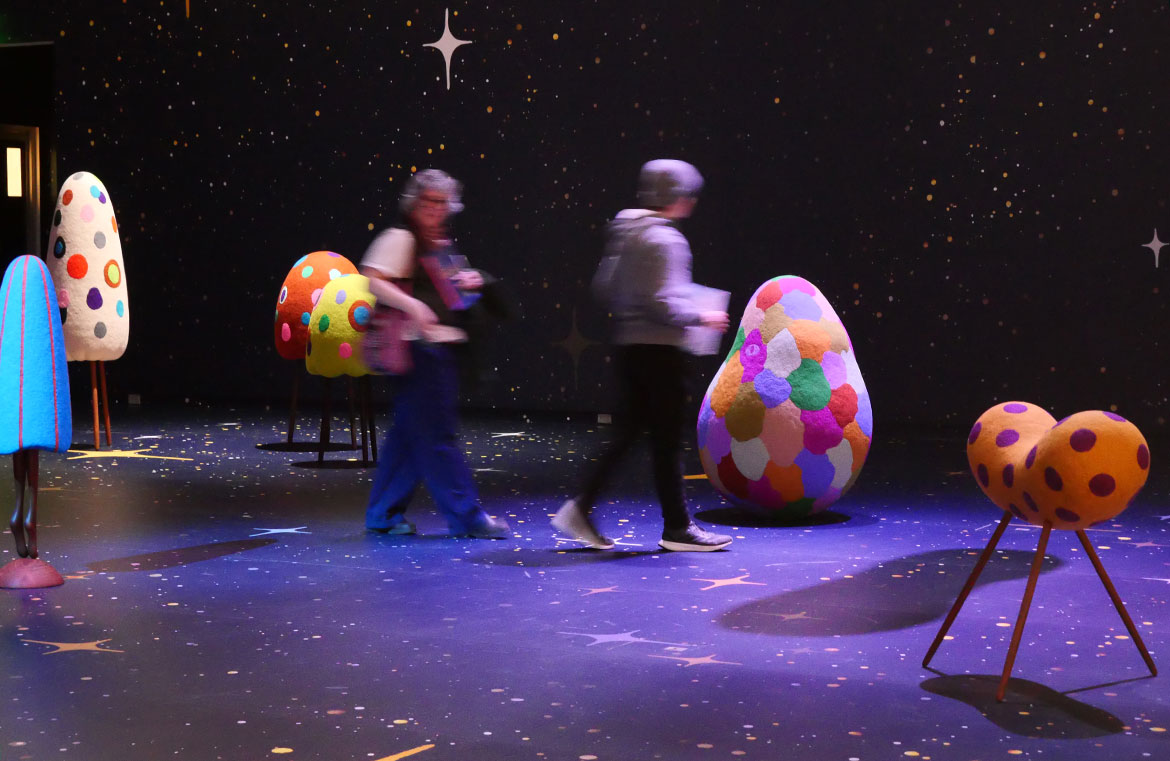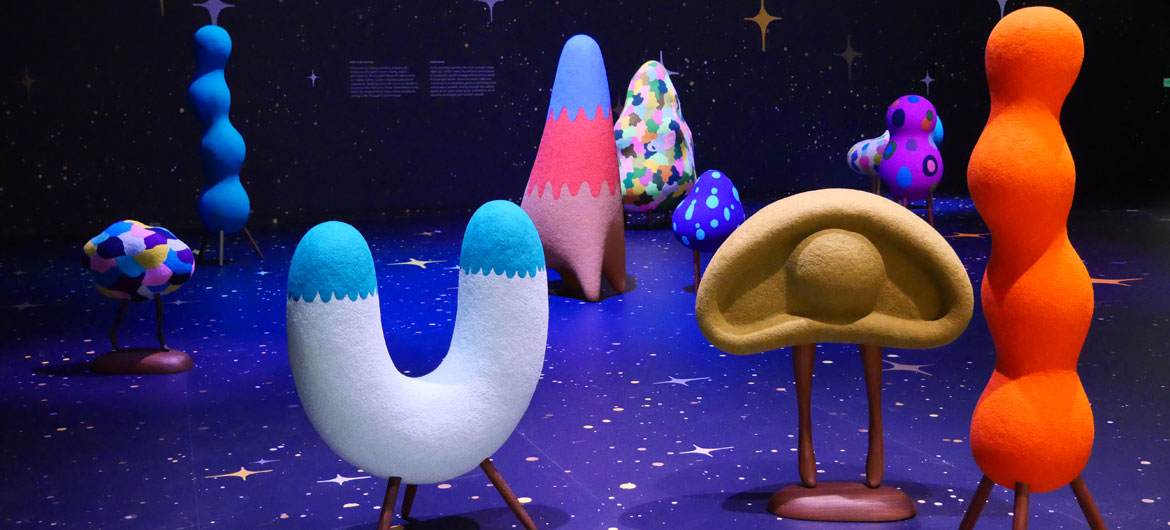
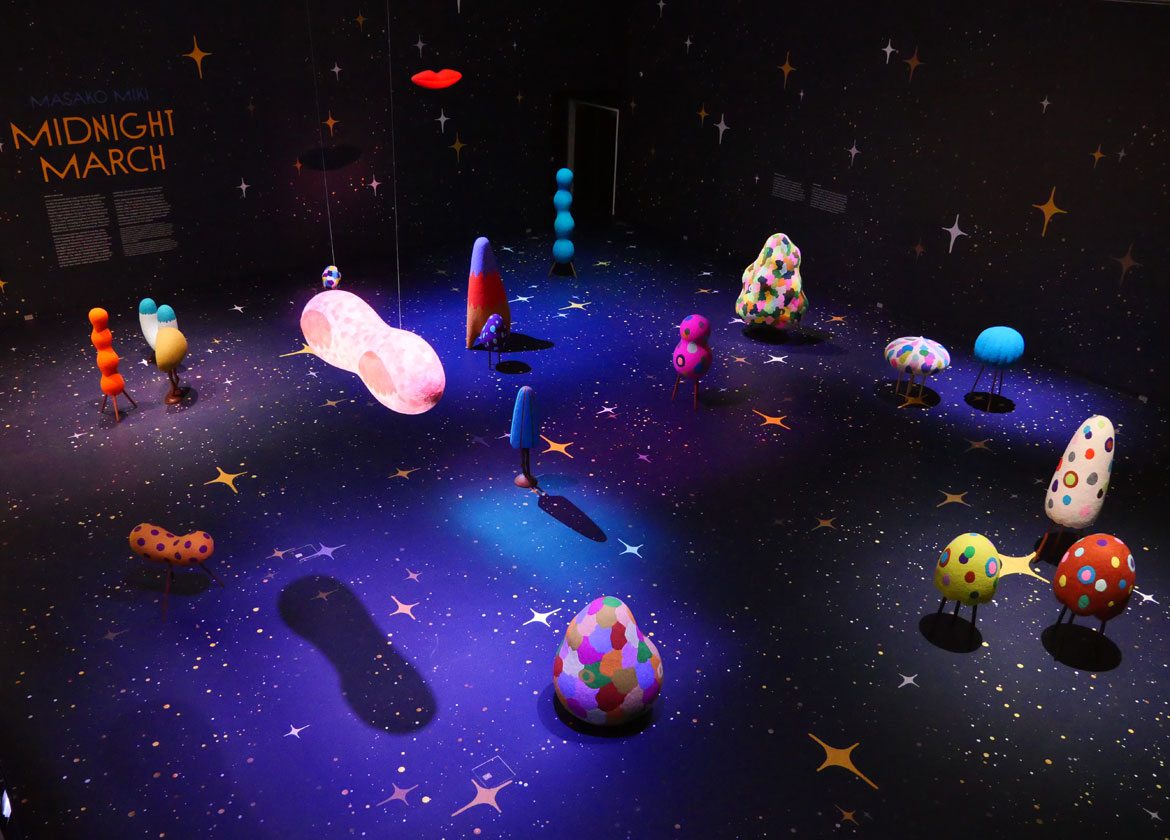
The creatures populating the exhibit “Masako Miki: Midnight March,” on view the MassArt Art Museum in Boston from Jan. 29 to May 31, 2026, are delightful furry soft things, dotted and striped, sort of like outer space mushrooms, some supported on wooden tripods, others standing on human-like feet standing on tip-toes. The feeling of strolling among them in the big dark gallery, the walls and floor decorated with stars, is like a cosmic walk-through theme park dark ride, charming and wondrous. It’s one of the best exhibits of 2026.
Miki describes the felted-wool stretched over foam sculptures as mushrooms, shapeshifters, clouds, pine trees, horses, prayer beads, umbrellas, a “cloth deity.” They come alive with spirits and haunts when you read their names: “Waterdrop From A Million Years Ago,” “Aged Camellia Flower Spirit,” “Sashiko Ghost,” “Sentient Roly-Poly,” “Possessed Ancient Monolith Ghost,” “Ancient Tree Witness,” “One Million-Year Old Horse,” “Enchanting Lips Shapeshifter,” “Umbrella’s Whispers,” “Descending Cloud Seeing A Path Forward.”
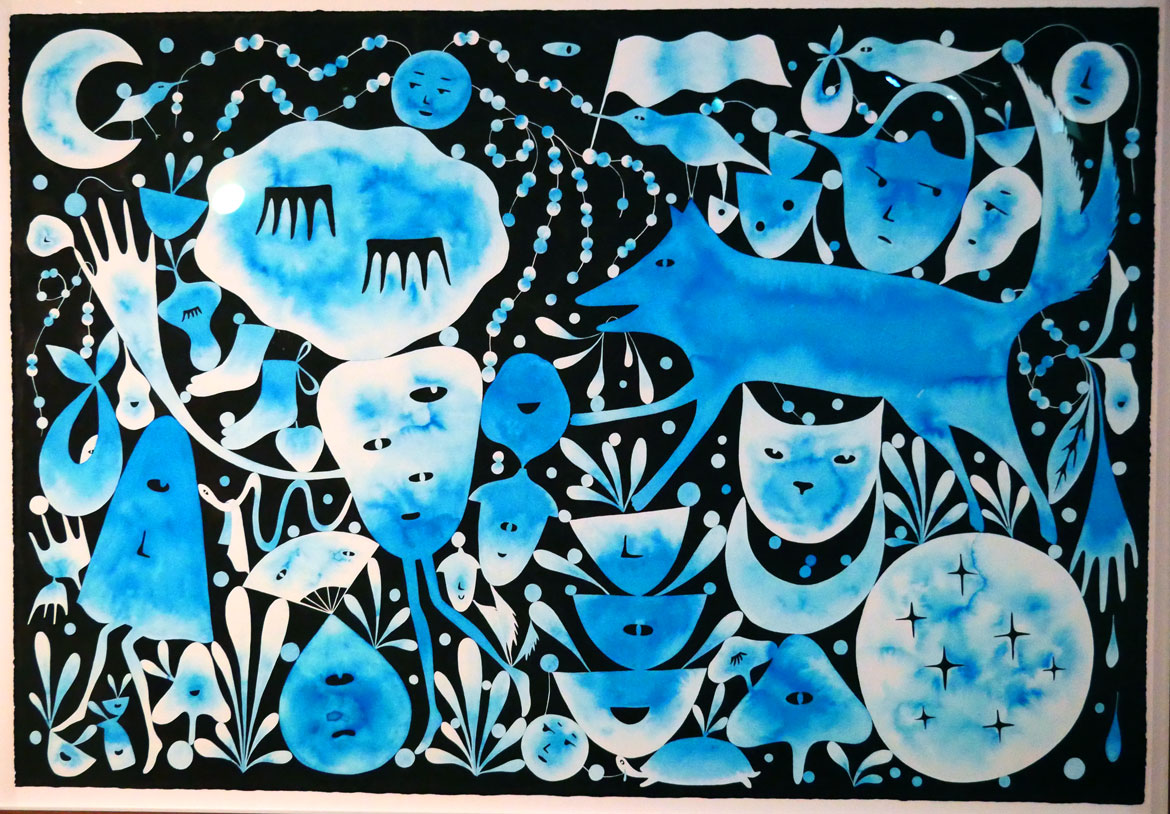
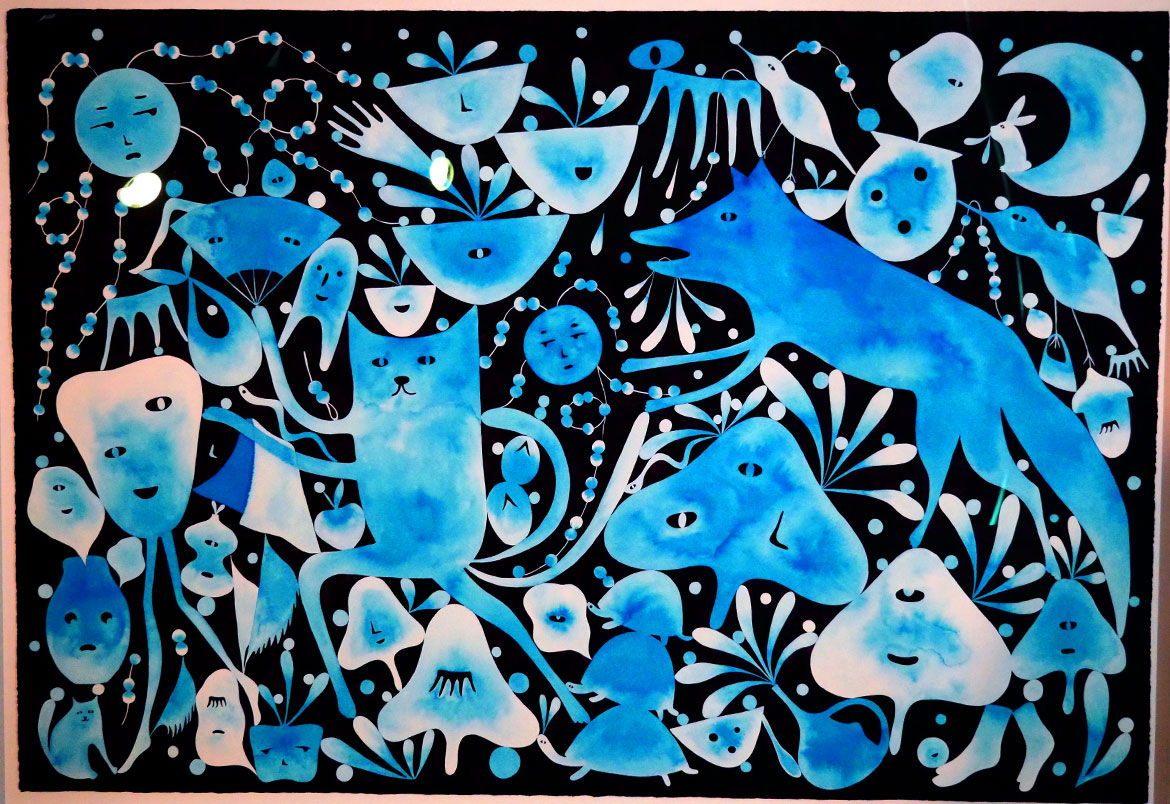
“Referencing nature, Japanese yōkai (supernatural beings), and Shintoism, Miki creates new mythologies that reflect the complexity of multicultural identities and worlds,” according to the museum.
“These characters often stem from the Hyakki Yagyō, or the ‘Night Parade of One Hundred Demons,’ a tradition where supernatural beings march through the streets at night,” MassArt Art Museum Director Lisa Tung told UK publication Art Plugged in February 2026.
Miki, who was born in 1973 in Osaka, Japan, has lived for three decades in California, currently in Berkeley. “The Shapeshifter series started because I wanted to share my process of dealing with dilemmas and questions concerning my bicultural identity between Japan and the US,” Miki told the UK publication Art Plugged in 2021. “I began to explore these questions by referencing Japanese traditions based on Shinto’s animism. Yōkai (shapeshifters) appear in my ancestral mythologies and folklore. The simple translation of yōkai would be something like ghosts, deities, or preternatural creatures. Yōkai appear as different forms like human, animal, natural object, and man-made objects. Yōkai are not personifications of the spirit or ideas, the spirit is usually experienced through the unique physical entity. It’s a bit difficult to define who/what they are because they possess dual characteristics of being sacred and secular and animate and inanimate. … I felt these ancient yōkai characters offer interesting narratives that are relevant to our current society. In our non-binary society where multiculturalism, gender fluidity and biracial identity seem to be more the norm, our identities have become more complex than in the past.”
Miki worries that traditional myths can be harmful. “It’s kind of fascinating how these fictions can drive entire countries, nations and the world,” Miki told Louisville Public Media when she had an exhibition of some similar sculptures at at KMAC Contemporary Art Museum in Louisville, Kentucky in 2023. “If you manipulate and communicate them well enough, people believe them, and this is a big part of us, bringing us together, but in a really negative cause. We have too many of these manipulative myths that we need to get rid of, I think. We really need to update them.”
“I hope these characters are a reflection of who we can become,” Miki said of her creations in 2023. “That we celebrate the diversity, we celebrate the idiosyncrasies. They’re very independent identities; they’re not conforming to a particular identity that has been accepted in folklore and mythologies. … If we can’t imagine better, I don’t think we can move forward.”
If this is the kind of coverage of arts, cultures and activisms you appreciate, please support Wonderland by contributing to Wonderland on Patreon. And sign up for our free, occasional newsletter so that you don’t miss any of our reporting. (All content © Greg Cook 2026 or the respective creators.)